

Estrogen receptor-positive (ER+), human epidermal growth factor receptor 2-negative (HER2-) breast cancer represents approximately 70% of all breast cancer cases, making it the most common molecular subtype. While first-line treatment with endocrine therapy combined with cyclin-dependent kinase 4/6 (CDK4/6) inhibitors has improved outcomes, treatment resistance inevitably develops in most patients. This resistance is frequently driven by genetic alterations, particularly ESR1 mutations which occur in 40-50% of patients receiving endocrine therapy and CDK4/6 inhibitors for metastatic disease. The emergence of proteolysis-targeting chimeras (PROTACs) represents a novel therapeutic approach to overcome these resistance mechanisms. In a recent study published in the New England Journal of Medicine, the VERITAC-2 phase 3 trial in patients with ER-positive, HER2-negative advanced breast cancer found that vepdegestrant (ARV-471), an oral PROTAC estrogen receptor degrader, achieved significantly longer progression-free survival compared with fulvestrant in the subgroup with Estrogen Receptor 1 (ESR1) mutations (1). Fulvestrant (Faslodex) is primarily used to treat advanced or metastatic breast cancer in postmenopausal women.
The Estrogen Receptor as a Therapeutic Target in Breast Cancer
The estrogen receptor (ER) is a nuclear hormone receptor acting as a ligand-activated transcription factor. In ER+ breast cancer, estrogen binding induces dimerization, DNA binding, and co-regulator recruitment, driving transcription of genes that promote cell growth and survival (2). Endocrine therapies, Selective Estrogen Receptor Modulators (SERMs,) aromatase inhibitors (AIs), and Selective Estrogen Receptor Degraders (SERDs), are the cornerstones for ER+ disease (3, 4).
Resistance, however, is common, with ESR1 ligand-binding domain mutations enabling ligand-independent ER activation and altering receptor conformation, limiting traditional therapy efficacy. Fulvestrant, the first SERD, has drawbacks including poor bioavailability, intramuscular delivery, and reduced activity against some ESR1 mutations, spurring the development of new ER-targeting agents with superior pharmacologic profiles (5).
PROTAC Technology: Mechanism and Advantages
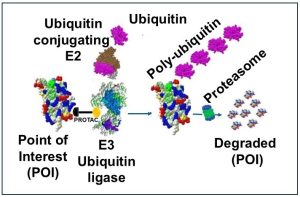
Proteolysis-targeting chimeras (PROTACs) are an innovative therapeutic strategy that exploits the cell’s ubiquitin-proteasome system to degrade disease-causing proteins (Read our blog articles for more details (6-14)). Unlike conventional inhibitors that only block protein function, PROTACs enable complete elimination of the target protein. These heterobifunctional molecules consist of a ligand that binds the protein of interest (POI), a ligand that recruits an E3 ubiquitin ligase, and a linker connecting the two. By simultaneously binding the POI and the E3 ligase, PROTACs form a ternary complex that positions the ligase to transfer ubiquitin molecules onto the POI. The resulting polyubiquitinated protein is recognized and degraded by the proteasome. This catalytic mechanism allows a single PROTAC molecule to trigger degradation of multiple target molecules. PROTACs can address proteins lacking enzymatic activity, overcome resistance mutations that impair inhibitor binding, and achieve more complete target elimination than traditional inhibitors or even SERDs.
Vepdegestrant is an orally bioavailable PROTAC designed to target the estrogen receptor for degradation. Unlike SERDs like fulvestrant, which function primarily as ER antagonists that indirectly lead to ER degradation, vepdegestrant simultaneously binds ER and an E3 ligase, forming a ternary complex that results in direct polyubiquitination of ER and its subsequent degradation by the proteasome. Preclinical studies demonstrated that vepdegestrant could degrade both wild-type and mutant ER in vitro and showed more robust ER degradation and tumor growth inhibition than fulvestrant in xenograft models.
The VERITAC-2 Clinical Trial
The VERITAC-2 trial was a phase 3, multinational, open-label, randomized study designed to evaluate the efficacy and safety of vepdegestrant compared with fulvestrant in patients with ER+, HER2- advanced breast cancer who had previously received endocrine therapy and a CDK4/6 inhibitor.
PROTAC ER Degradation Improves Outcomes in ESR1-Mutant Endocrine-Resistant Breast Cancer
The VERITAC-2 trial shows that targeted ER degradation via PROTAC technology can improve outcomes in endocrine-resistant breast cancer, particularly with ESR1 mutations. In this Phase 3 study, vepdegestrant nearly doubled median progression-free survival (PFS) compared to fulvestrant (5.0 vs 2.1 months) in ER-positive, HER2-negative advanced disease with ESR1 mutations, alongside a higher objective response rate (18.6% vs 4.0%). These results indicate both delayed progression and tumor shrinkage in a subset of patients. All trial participants had prior CDK4/6 inhibitor exposure but no prior fulvestrant, and the control arm’s performance aligned with expectations, supporting the validity of the observed benefit. These data suggest vepdegestrant could become a new standard endocrine option for ESR1-mutant advanced breast cancer, pending approval, offering a differentiated mechanism and favorable safety profile.
These results emphasize biomarker-driven therapy in hormone receptor-positive breast cancer. ESR1 mutations are now recognized as a key driver of endocrine resistance and a viable therapeutic target. Until recently, treatment options for ESR1-mutant disease were limited. Elacestrant, approved after the EMERALD trial, improved median PFS to 3.8 months vs 1.9 with standard therapy. Other oral SERDs, such as imlunestrant in EMBER-3, showed roughly 2-month gains over control. In comparison, vepdegestrant’s ESR1-mutant PFS benefit of nearly 3 months and higher ORR appear at least as strong as prior agents, though cross-trial comparisons have limitations.
ESR1-Wildtype Disease Remains a Therapeutic Challenge
In ESR1-wildtype disease, vepdegestrant did not improve PFS over fulvestrant (3.8 vs 3.6 months), consistent with limited benefits of endocrine monotherapy post-CDK4/6 inhibition. These tumors often rely on alternative growth pathways, making ER suppression alone insufficient. The authors suggest ESR1-mutant cancers retain endocrine sensitivity if ER is effectively degraded, while wildtype tumors exploit other “escape routes.” Fulvestrant and vepdegestrant performed similarly in the wildtype subset, highlighting the need for combination strategies targeting additional pathways.
Mechanistically, the lack of superiority in wildtype tumors despite greater ER degradation suggests that ER removal alone is inadequate when other drivers dominate. In ESR1-mutant cancers, however, vepdegestrant’s PROTAC mechanism, ubiquitination and degradation of ER, outperformed fulvestrant, likely overcoming its poor bioavailability and reduced activity against mutant receptors. This validates targeted protein degradation as a strategy to address mutation-driven resistance and represents one of the first Phase 3 successes for PROTACs in oncology.
Favorable Safety Profile with Oral Administration Advantage
Vepdegestrant was generally well tolerated. As an oral therapy, it avoids the inconvenience and discomfort of monthly injections. Fatigue was the most common side effect (26.6% vs 15.6% with fulvestrant), but severe cases were rare (1%). Liver enzyme elevations occurred in ~14% of patients, mostly low grade, and gastrointestinal toxicity was mild, with lower nausea and vomiting rates than seen with other oral SERDs. Diarrhea was uncommon, and no significant cardiac effects were detected. Overall, adverse events were predominantly grade 1–2, with few discontinuations.
Clinical Path Forward and Paradigm Shift Potential
Clinically, vepdegestrant could fill a treatment gap for ESR1-mutant advanced breast cancer, offering meaningful PFS gains and tumor shrinkage where fulvestrant often fails. If approved, ESR1 mutation testing at progression could guide its use as second-line therapy, and future trials may explore earlier-line or combination strategies. The trial confirms PROTAC ER degradation as an effective approach and supports further development of targeted protein degraders in oncology.
Conclusion
Vepdegestrant is a promising therapy for ER+, HER2– advanced breast cancer, especially in ESR1-mutant disease progressing after CDK4/6 inhibitors and endocrine therapy. As a PROTAC ER degrader, it uses the ubiquitin-proteasome system to eliminate the target protein rather than merely inhibit it.
In VERITAC-2, vepdegestrant significantly improved progression-free survival and response rates over fulvestrant in ESR1-mutant tumors, with a manageable safety profile. This underscores PROTAC technology’s potential to address hard-to-target proteins in oncology.
Ongoing follow-up will clarify survival and durability of benefit. Future studies should evaluate combinations with other targeted agents to overcome resistance in ESR1 wild-type disease. Vepdegestrant’s success marks a key step in translating PROTAC technology into tangible clinical impact, opening the door for next-generation protein degraders in cancer therapy.
References
1. Vepdegestrant, a PROTAC Estrogen Receptor Degrader, in Advanced Breast Cancer. N Engl J Med 2025;393:556-568 DOI: 10.1056/NEJMoa2505725.
2. Estrogen Receptor Signaling in Breast Cancer. Cancers (Basel). 2023 Sep 23;15(19):4689. doi: 10.3390/cancers15194689.
3. A Promising Strategy for Estrogen Receptor Positive Endocrine-Resistant Breast Cancer. J Med Chem. 2020 Dec 24;63(24):15094-15114. doi: 10.1021/acs.jmedchem.0c00913.
4. Next-generation selective estrogen receptor degraders and other novel endocrine therapies for management of metastatic hormone receptor-positive breast cancer: current and emerging role. Ther Adv Med Oncol. 2022 Jul 30;14:17588359221113694. doi: 10.1177/17588359221113694.
5. A phase I dose escalation and expansion trial of the next-generation oral SERD camizestrant in women with ER-positive, HER2-negative advanced breast cancer: SERENA-1 monotherapy results. Annals of Oncology, 2024, 35: 707-717; https://doi.org/10.1016/j.annonc.2024.04.012
6. Advancing PROTAC Therapeutics: Potency Assays for FDA Compliance
9. From PROTACs to PROTAVs: A New Era in Cancer Vaccine Development
10. PROTACs for Innovative Drug Development: Current Trends and Future Prospects
11. Recent PROTAC Patent Publications and Target Proteins
12. Cutting-Edge PROTACs: Ready to Transform Clinical Oncology
14. Aspirin as a PROTAC and Molecular Glue Antagonist: A Conceptual Exploration Based on Recent Findings
Disclaimer: This blog post is intended solely for educational and scientific informational purposes. Any mention of therapeutic drug names, including FDA-approved medications, is for the purpose of accurate reporting and discussion of biomedical research and does not constitute medical advice, endorsement, or promotion. Readers should not interpret the content as a recommendation for any specific treatment. Always consult a qualified healthcare professional for medical advice or treatment decisions.
About Marin Biologic Laboratories
Our Recent Publication/Meeting Presentation on Gene Therapy
1. Development of VNX-101, an Adeno-Associated Virus with Less Immunogenicity and Efficient Long-Term Expression of a CD19 T-Cell Engager. Molecular Therapy Methods & Clinical Development, published online July 24, 2025. DOI: 10.1016/j.omtm.2025.101541
2. Development of a Pharmacokinetic (PK) Mouse Serum GLP ELISA for an Anti–CD19–AntiCD3 Diabody
3. Cell-Based Potency Assay for Anti-CD3-Anti-CD19 Diabody. 2025.04.15.648836v1 https://www.biorxiv.org/content/10.1101/2025.04.15.648836v1.
4. American Society of Hematology (ASH) Annual Meeting 2024.
Abstract link: Using Gene Therapy to Solve Challenges with CAR-T Cell Immunotherapy: Lead Selection and Preclinical Development of an Adeno-Associated Virus with Reduced Immunogenicity Exhibiting Efficient and Long-Term Expression of an Anti-CD19 T-Cell Engager.
Comprehensive Assay Solutions for In Vitro and Cell Based Potency Assays and Pharmacokinetics Studies- Our Expertise
With 30 years of expertise in cell culture, cell-based assays, and preclinical/clinical PK/PD analysis, we specialize in offering assay services essential for a wide variety of therapeutic drug development programs, preclinical studies, IND/BLA applications, and commercialization. Our comprehensive services include both preclinical non-GLP and GLP assays, as well as non-GMP and GMP assays, providing critical support throughout the entire development pipeline.
Watch the following video and explore our latest presentation on the development and validation of potency and pharmacokinetic (PK) assays for AAV vectors, highlighting innovative methodologies and industry-leading expertise.
Download the full presentation: Development of Custom Cell Based and In vitro Potency and Pharmacokinetics (PK) Assays for AAV vectors- Marin biologic Laboratories
Development of Cell-Based Potency Assays: Case Studies and Blogs from Marin Biologic Laboratories (MarinBio)




Drug Discovery & Development Assays Offered by Marin Biologic Laboratories (MarinBio)
- ADME/Tox
- Molecular Biology
- The Art of Cell Culture
- Exosomes
- Stability Services
- Potency Assay
- Gene Therapy Assays
- Immunotherapy Assays
- Antiviral Therapy Assays
- cGMP
- MLR
- Cell Based Assays
- ELISA
- Flow Cytometry
- Protein
- PCR-qPCR
- Immunoassay
- Radioimmunoassay
- GLP
- Transfection
- Cell Therapy Assays
- Targeted Protein Degradation
- Research to Commercialization
