

Introduction
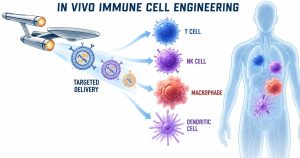
CRISPR-based genome editing has transformed the ability to manipulate immune cells for the treatment of cancer, autoimmune disease, and other conditions involving immune dysfunction. The most clinically advanced approaches have largely relied on ex vivo editing, in which T cells are collected, genetically modified, characterized, and reinfused. Although this strategy provides substantial control over editing efficiency and cellular quality, cell collection, manipulation, expansion, quality-control testing, and reinfusion create a complex and costly manufacturing process that can limit scalability and patient access. In vivo genome editing offers an alternative approach in which immune cells are genetically modified directly within the patient. Advances in CRISPR–Cas9, base editing, and site-specific transgene insertion have further expanded this concept from simple gene disruption toward precise correction and functional reprogramming, including direct generation of CAR-expressing immune cells.
The major technological barrier to this transition is efficient and selective delivery. Immune cells comprise heterogeneous populations distributed throughout the blood, bone marrow, lymphoid organs, and peripheral tissues, requiring delivery systems capable of reaching and selectively modifying the desired cells while limiting exposure of non-target populations. Recent advances in ionizable and targeted lipid nanoparticles (LNPs), polymer–lipid nanoparticles, viral and virus-like particles, and receptor-directed delivery systems are beginning to address these challenges. Antibodies, nanobodies, and other targeting ligands can provide cellular specificity, while improvements in receptor-mediated internalization, intracellular trafficking, and endosomal escape increase functional delivery of CRISPR–Cas9, base editors, and therapeutic transgenes. These technologies are expanding opportunities for direct engineering of T cells, NK cells, and macrophages, but their clinical success will ultimately depend on achieving sufficient editing efficiency while controlling biodistribution, off-target activity, immunogenicity, genotoxicity, and unintended modification of non-target cells.
In Vivo Engineering of T Cells
T cells are particularly attractive targets for in vivo engineering because conventional autologous CAR-T therapy illustrates many of the limitations of ex vivo manufacturing. Production of CAR-T cells requires collection and processing of patient T cells followed by genetic modification, expansion, testing, and reinfusion. In vivo engineering instead seeks to transform endogenous T cells directly into therapeutic cells, potentially eliminating the need to manufacture a separate cellular product.
Recent advances provide proof of principle for this concept. Targeted viral and nonviral delivery systems can introduce genetic material selectively into circulating or lymphoid T cells, and early clinical studies of in vivo CAR-T generation have begun to demonstrate that therapeutically relevant numbers of engineered cells can be generated directly within patients. A recent report, for example, described in vivo generation of CD19 CAR-T cells using lipid nanoparticles in patients with refractory systemic lupus erythematosus, resulting in B-cell depletion and reductions in disease activity. More broadly, early clinical experience with targeted in vivo CAR-T cell platforms has provided evidence of T-cell transduction, CAR expression, and therapeutic activity, although these technologies remain considerably less mature than conventional ex vivo CAR-T manufacturing.
CRISPR editing could extend this concept beyond simple CAR expression. Rather than randomly introducing a transgene, CRISPR enables disruption, replacement, or site-specific insertion of genetic sequences. Resent research has demonstrated in vivo site-specific engineering of human T cells, using targeted delivery of CRISPR-Cas9 components together with a DNA donor to insert CAR sequences into a defined T-cell locus. Therapeutically relevant CAR-T cell populations were generated directly in humanized mouse models, demonstrating the feasibility of combining in vivo delivery with precise genomic integration.
Molecular and Cellular Advances in In Vivo Delivery to Immune Cells
Recent advances in nanotechnology, molecular engineering, and immune-cell biology are beginning to overcome one of the principal barriers to in vivo genome editing, the efficient and selective delivery of editing cargo to defined immune-cell populations. Conventional lipid nanoparticles (LNPs) exhibit strong tissue and cell-type biases, particularly toward the liver, whereas newer targeted LNPs (tLNPs) incorporate antibodies, antibody fragments, nanobodies, or engineered ligands that recognize immune-cell surface receptors and promote receptor-mediated internalization. Importantly, receptor selection is increasingly being guided not simply by cell-surface abundance but by internalization kinetics; rapidly cycling receptors such as CD2 and CD7 can enhance nanoparticle uptake and mRNA delivery to primary T cells, including T cells in blood and lymphoid tissues.
Advances in surface chemistry have also improved ligand orientation and accessibility. For example, nanobody-based antibody-capture systems can orient targeting antibodies on LNP surfaces without extensive chemical modification, producing highly selective systemic delivery to CD4⁺ and CD8⁺ T cells while minimizing uptake by unrelated immune populations. In parallel, ionizable-lipid optimization, polymer–lipid hybrid nanoparticles, and improved endosomal-escape chemistries are increasing cytoplasmic delivery of mRNA and genome-editing components.
Some delivery vehicles are now being engineered to perform a dual function, simultaneously delivering genetic cargo and manipulating intracellular signaling or metabolism. For example, a 2026 polymer–lipid nanoparticle, promoted T-cell transfection, activation, metabolic reprogramming, and expansion while limiting exhaustion, enabling CAR-T cells to be generated directly in vivo. Targeting is also expanding beyond T cells: engineered biparatopic ligands have recently enabled LNP-mediated mRNA delivery to NK cells with high selectivity, demonstrating that receptor-directed nanoparticle design can potentially be adapted to distinct lymphoid and myeloid populations.
Collectively, these developments represent a shift from passive nanoparticle biodistribution toward molecularly programmed delivery systems in which particle composition, surface ligands, receptor internalization, endosomal escape, and immune-cell signaling are engineered together. Such approaches should improve the therapeutic index of in vivo CRISPR editing by increasing editing efficiency in the desired immune-cell subset while reducing systemic exposure and unintended modification of non-target cells.
Delivery of CRISPR and CAR Constructs to T Cells, NK Cells, Macrophages and Dendritic cells
The development of effective in vivo delivery systems is enabling increasingly sophisticated genetic engineering of T cells, natural killer (NK) cells, macrophages and dendritic cells.
. Ligand-directed LNPs have achieved highly selective mRNA delivery to NK cells and direct generation of functional CAR-NK cells in vivo, demonstrating that receptor-targeted nanoparticle platforms can be adapted to otherwise difficult-to-transfect immune populations.
Macrophages are emerging as important targets for direct in vivo genetic reprogramming because of their efficient phagocytic activity, extensive tissue distribution, and ability to infiltrate solid tumors. Targeted nanoparticle systems can exploit macrophage-associated surface receptors such as CD206 (MRC1) to enhance receptor-mediated uptake, while myeloid-tropic LNPs and engineered virus-like particles provide alternative approaches for delivering mRNA and genome-editing machinery. These systems create opportunities both to introduce therapeutic receptors and to modify endogenous pathways controlling macrophage phenotype and function. For example, targeted delivery of CAR mRNA can generate CAR-expressing macrophages directly in vivo, providing antigen-specific tumor recognition without requiring ex vivo macrophage isolation and engineering. Genome editing or RNA-mediated modulation of SIRPα, a component of the CD47–SIRPα phagocytosis checkpoint, may further enhance tumor-cell engulfment, while manipulation of regulators such as TNFAIP3, ARG1, and IRF5 can potentially shift macrophages from immunosuppressive or tumor-supporting states toward inflammatory and tumoricidal phenotypes. Thus, macrophage-directed delivery provides an opportunity to combine antigen-specific recognition with stable or transient reprogramming of innate immune function.
Dendritic cells provide a complementary target because genetic modification of these professional antigen-presenting cells can indirectly amplify both innate and adaptive antitumor immunity. Cell-selective delivery can exploit receptors associated with dendritic-cell subsets, particularly CLEC9A (DNGR-1) and DEC205 (LY75), which promote receptor-mediated uptake and can preferentially target conventional type 1 dendritic cells (cDC1), a population specialized for antigen cross-presentation and activation of CD8⁺ T cells. Targeted nanoparticles can therefore deliver mRNA, CRISPR components, antigens, or immunomodulatory cargo directly to DC populations. Functional genome editing provides an additional level of control; for example, CRISPR-mediated disruption of PD-L1 (CD274) can remove inhibitory signaling from dendritic cells and enhance their capacity to stimulate T-cell responses. Delivery systems targeting CLEC9A or DEC205 can also be used to manipulate innate immune pathways such as STING, thereby promoting DC maturation, antigen presentation, and downstream cytotoxic T-cell activation. In contrast to CAR-T or CAR-NK engineering, where the primary objective is generally to generate a directly cytotoxic effector cell, dendritic-cell engineering may be particularly valuable for amplifying and directing endogenous immune responses through improved antigen presentation and T-cell priming.
Table 1. Multilevel molecular targeting strategies for in vivo immune-cell engineering.
| Immune cell | Cell-selective strategy | Delivered cargo | Functional target | Desired outcome |
| T cell | CD3, CD4, CD7, CD8 | CRISPR-Cas9, base editor, CAR mRNA, donor DNA | TRAC | Site-specific CAR insertion and controlled CAR expression |
| T cell | CD3/CD7 targeting | CRISPR-Cas9 | PDCD1, CISH, SOCS1, TGFBR2 | Increased activation, persistence and resistance to tumor immunosuppression |
| T cell | T-cell-targeted LNP/viral vector | CAR mRNA or CAR DNA | CAR expression | Direct generation of CAR-T cells in vivo |
| NK cell | NK-selective biparatopic ligands | CAR mRNA | CAR expression | Direct generation of CAR-NK cells in vivo |
| NK cell | NKG2A-associated/selective targeting | CAR mRNA ± functional modulation | NKG2A/KLRC1 | CAR-mediated recognition plus reduced inhibitory signaling |
| Macrophage | CD206-targeted nanoparticle | RNA/CRISPR cargo | SIRPα, ARG1, IRF5, TNFAIP3 | Increased phagocytosis and/or proinflammatory reprogramming |
| Macrophage | Myeloid-tropic LNP/VLP | CRISPR-Cas9/base editor | TNFAIP3 and other polarization regulators | Stable conversion toward tumoricidal macrophage phenotype |
| Dendritic cell | CLEC9A | CRISPR/RNA/immunomodulator | PD-L1 or immune-activation pathways | Increased cDC1 activation and T-cell priming |
| Dendritic cell | CLEC9A + DEC205 | RNA or immunomodulatory cargo | STING/antigen-presentation pathways | Enhanced cross-presentation and CD8⁺ T-cell activation |
Cell-selective receptors or delivery mechanisms direct nanoparticles, viral vectors or virus-like particles to T cells, NK cells, macrophages or dendritic cells. These vehicles deliver mRNA, CRISPR-Cas systems, base editors or therapeutic transgenes that subsequently modify functional targets controlling antigen recognition, immune checkpoints, cellular activation, polarization and persistence. Combining delivery-level specificity with intracellular or genomic targeting provides multiple layers of control and may enable direct generation of therapeutically engineered immune-cell populations in vivo.
Potential for a More Accessible Therapeutic Platform
Perhaps the most important long-term advantage of in vivo genome editing is its potential to transform genome editing from a specialized cellular manufacturing procedure into a programmable drug platform. The feasibility of systemic in vivo genome editing is increasingly supported by clinical experience outside the hematopoietic system. Lipid nanoparticle delivery has already enabled systemic CRISPR editing and base editing in humans, including clinical targeting of hepatic genes and the development of an individualized base-editing therapy for a child with a severe metabolic disease. These studies establish that editing machinery can be formulated, systemically administered, and used to modify cells directly within patients.
The central challenge for in vivo CRISPR editing is therefore increasingly one of delivery rather than genome-editing capability alone. Therapeutic success requires sufficient editing of the intended cell population while minimizing exposure of unrelated cells and tissues. Unlike ex vivo approaches, the edited cell population cannot be comprehensively characterized before treatment. Biodistribution, off-target genome modification, immune responses against editing components, unintended modification of non-target cell populations, and the duration of editor exposure therefore become particularly important safety considerations.
Conclusion
In vivo genome editing represents an important evolution of CRISPR-based cell and gene therapy, potentially shifting cellular engineering from specialized manufacturing facilities directly to the patient. Whereas ex vivo editing provides substantial control over cell selection, genome modification, and product characterization, its dependence on individualized cell collection, manipulation, testing, and reinfusion creates significant logistical and economic barriers. Advances in targeted LNPs, polymer–lipid nanoparticles, engineered viral and virus-like particles, and receptor-specific ligands are increasingly enabling CRISPR–Cas9, base editors, and therapeutic transgenes to reach defined hematopoietic populations. Direct engineering of endogenous T cells and NK cells could simplify CAR-based immunotherapies, Together, these developments raise the possibility of converting complex individualized cell therapies into more scalable and accessible genetic medicines.
The principal challenge is achieving sufficient editing while maintaining stringent cellular and genomic specificity. Because cells edited in vivo cannot be comprehensively characterized before therapeutic effects occur, delivery specificity, biodistribution, receptor-mediated uptake, endosomal escape, off-target editing, immunogenicity, and genotoxicity become integral components of therapeutic safety. Future progress will therefore require coordinated engineering of the delivery vehicle, targeting ligand, genetic cargo, editing system, and target cell, rather than optimization of genome-editing activity alone. The central question is increasingly not whether CRISPR can produce a desired genetic modification, but whether that modification can be generated selectively, efficiently, and safely in the appropriate cells within a living patient.
References
- Nyberg WA, Bernard PL, Ngo W, Wang CH, Ark J, Rothrock A, et al. In vivo site-specific engineering to reprogram T cells. Nature. 2026;652(8110):712-721. doi:10.1038/s41586-026-10235-x. PMID: 41851456. PubMed
PubMed record
Highly relevant: Demonstrates CRISPR-Cas9-mediated, site-specific CAR insertion directly into T cells in vivo, generating therapeutic CAR-T cells in humanized mouse models. - Xu S, Liang D, Wang Q, Cheng Y, Xie D, Gui Y, et al. In vivo genome editing of human haematopoietic stem cells for treatment of blood disorders using mRNA delivery. Nat Biomed Eng. 2026;10(3):473-489. doi:10.1038/s41551-025-01480-y. PMID: 40796944. PubMed
PubMed record
Highly relevant: Uses targeted LNPs to deliver base-editing machinery to human HSCs in vivo and edit HBG1/2, supporting a nonviral approach for hemoglobinopathies. - Botchkarev VV Jr, Harrington S, Stoppato M, Justen A, Kimber C, Kapuria A, et al. In vivo gene editing of human hematopoietic stem and progenitor cells using envelope-engineered virus-like particles. Nat Biotechnol. 2025 Dec 5. doi:10.1038/s41587-025-02915-2. PMID: 41350944. PubMed
PubMed record
Highly relevant: Demonstrates VLP-mediated editing of long-term human HSPCs in vivo, including B2M, BCL11A, and HBG1/2, and evaluates CD133-targeted delivery. - Aalipour A, Barreiro A, Garmilla A, Birnbaum ME. In vivo CAR T cell engineering: design principles and open questions. Trends Cancer. 2026;12(5):434-446. doi:10.1016/j.trecan.2026.01.007. PMID: 41887986. PubMed
PubMed record
Useful review: Discusses the rationale for generating CAR-T cells directly in patients, including manufacturing, delivery, efficacy, safety, and accessibility considerations. - Gao Y, Hu J, An N, Wen X, Li C. In vivo engineering of CAR-T cells: delivery strategies and clinical translation. J Hematol Oncol. 2026;14(1):23. doi:10.1186/s40364-026-00899-y. PMID: 41593732; PMCID: PMC12857126. PubMed
PubMed record
Useful review: Covers viral and nonviral strategies for direct CAR-T generation and the translational advantages and limitations of in vivo versus conventional ex vivo engineering. - Musunuru K, Grandinette SA, Wang X, Hudson TR, Briseno K, Berry AM, et al. Patient-specific in vivo gene editing to treat a rare genetic disease. N Engl J Med. 2025;392(22):2235-2243. doi:10.1056/NEJMoa2504747. PMID: 40373211; PMCID: PMC12713542. PubMed
PubMed record
Important clinical proof of principle: Demonstrates customized LNP-delivered base editing directly in a patient, providing strong clinical support for the broader feasibility of systemically administered in vivo genome editing.
Important ex vivo comparators
For the ex vivo versus in vivo comparison in your table, I would also cite the established clinical CRISPR HSPC literature:
- Frangoul H, Locatelli F, Sharma A, et al. Exagamglogene autotemcel for severe sickle cell disease. N Engl J Med. 2024;390:1649-1662. PubMed
- Locatelli F, Lang P, Wall D, et al. Exagamglogene autotemcel for transfusion-dependent β-thalassemia. N Engl J Med. 2024;390:1663-1676.
Disclaimer: This blog post is intended solely for educational and scientific informational purposes. Any mention of therapeutic drug names, including FDA-approved medications, is for the purpose of accurate reporting and discussion of biomedical research and does not constitute medical advice, endorsement, or promotion. Readers should not interpret the content as a recommendation for any specific treatment. Always consult a qualified healthcare professional for medical advice or treatment decisions.
About Marin Biologic Laboratories
Our Recent Publication/Meeting Presentation on Gene Therapy
1. Development of VNX-101, an Adeno-Associated Virus with Less Immunogenicity and Efficient Long-Term Expression of a CD19 T-Cell Engager. Molecular Therapy Methods & Clinical Development, published online July 24, 2025.
2. Cell-Based Potency Assay for Anti-CD3-Anti-CD19 Diabody. Journal of Immunological Methods. 2025. 545-114004.
3. Development of a Pharmacokinetic (PK) Mouse Serum GLP ELISA for an Anti–CD19–AntiCD3 Diabody
4. American Society of Hematology (ASH) Annual Meeting 2024.
Abstract link: Using Gene Therapy to Solve Challenges with CAR-T Cell Immunotherapy: Lead Selection and Preclinical Development of an Adeno-Associated Virus with Reduced Immunogenicity Exhibiting Efficient and Long-Term Expression of an Anti-CD19 T-Cell Engager.
Comprehensive Assay Solutions for In Vitro and Cell Based Potency Assays and Pharmacokinetics Studies- Our Expertise
With 30 years of expertise in cell culture, cell-based assays, and preclinical/clinical PK/PD analysis, we specialize in offering assay services essential for a wide variety of therapeutic drug development programs, preclinical studies, IND/BLA applications, and commercialization. Our comprehensive services include both preclinical non-GLP and GLP assays, as well as non-GMP and GMP assays, providing critical support throughout the entire development pipeline.
Watch the following video and explore our latest presentation on the development and validation of potency and pharmacokinetic (PK) assays for AAV vectors, highlighting innovative methodologies and industry-leading expertise.
Download the full presentation: Development of Custom Cell Based and In vitro Potency and Pharmacokinetics (PK) Assays for AAV vectors- Marin biologic Laboratories
Development of Cell-Based Potency Assays: Case Studies and Blogs from Marin Biologic Laboratories (MarinBio)




Drug Discovery & Development Assays Offered by Marin Biologic Laboratories (MarinBio)
- ADME/Tox
- Molecular Biology
- The Art of Cell Culture
- Exosomes
- Stability Services
- Potency Assay
- Gene Therapy Assays
- Immunotherapy Assays
- Antiviral Therapy Assays
- cGMP
- MLR
- Cell Based Assays
- ELISA
- Flow Cytometry
- Protein
- PCR-qPCR
- Immunoassay
- Radioimmunoassay
- GLP
- Transfection
- Cell Therapy Assays
- Targeted Protein Degradation
- Research to Commercialization
